Our Primary Learning Pathway brings together the strongest elements of two world‑class frameworks. The National Curriculum for England provides the clear progression, subject rigour and high academic expectations that underpin what our students learn. The IB Primary Years Programme (PYP) shapes how learning happens—through inquiry, conceptual understanding, student agency and authentic, connected experiences.
This blended approach ensures that every child benefits from structured knowledge development while also becoming an active, curious, reflective learner who can apply their understanding in meaningful ways. Learning is thematic, transdisciplinary and globally relevant, supported by specialist teachers.
A blended model: the academic rigour of the National Curriculum for England taught through the inquiry‑driven philosophy of the IB Primary Years Programme (PYP)
The International Baccalaureate (IB) Learner Profile
The IB Learner Profile sits at the heart of our Primary School culture. Across all year groups, students grow as Inquirers, Thinkers, Communicators, Risk‑takers, Knowledgeable, Caring, Principled, Open‑minded, Balanced and Reflective individuals—attributes that prepare them for success in school and in life.
Key Stage 1
[KG2 and Grade1]
(5 and 6 years old)
Building foundations through structured teaching and inquiry‑rich exploration
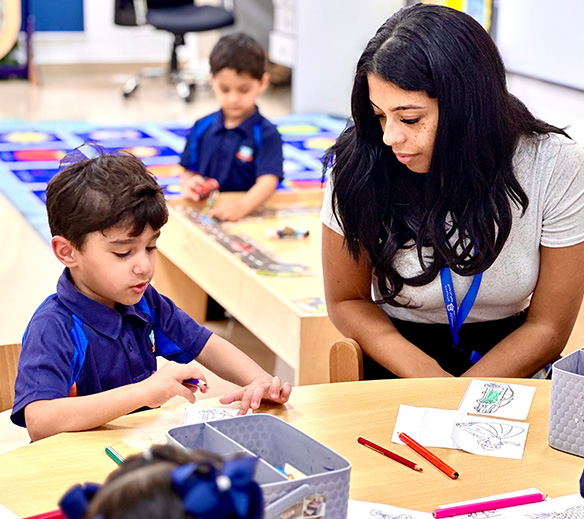
In Key Stage 1, children build on the early learning foundations established in Pre‑K and KG1. The National Curriculum for England guides the development of early literacy, numeracy and scientific understanding, while the PYP approach ensures learning is hands‑on, connected and driven by curiosity.
Phonics is taught systematically to secure early reading and spelling.
Learning experiences are designed around age‑appropriate inquiry, allowing children to explore ideas, ask questions and make connections.
Depth of learning is prioritised—students revisit and apply prior knowledge to demonstrate mastery.
The IB Learner Profile attributes are introduced explicitly, helping children begin to understand themselves as learners and community members.
This stage establishes the essential academic and personal foundations that support confident, independent learning.
Lower Key Stage 2
[Grades 2 and 3]
(7 and 8 years old)
Strengthening core knowledge while expanding independence and inquiry
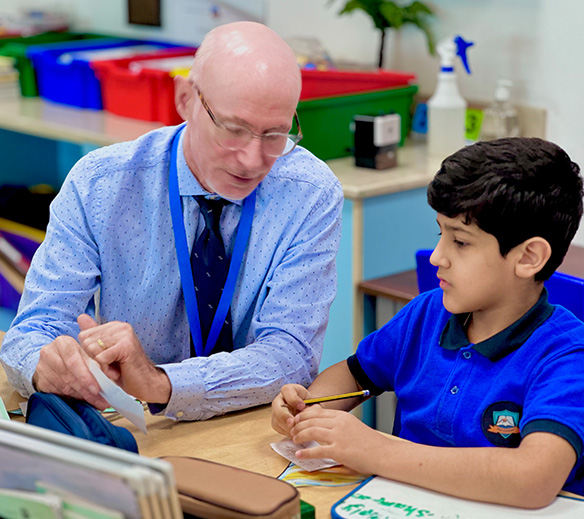
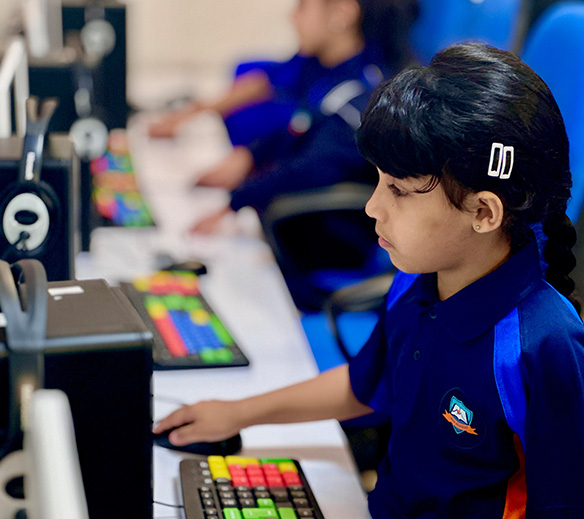
In Grades 2 and 3, students continue to study the core subjects—English, Mathematics, Science, Arabic, Islamic Education and Social Studies—with specialist teachers enriching learning in Art, Music, Computing and PE.
The National Curriculum ensures clear progression in knowledge and skills, while the PYP framework connects subjects through meaningful themes that encourage students to see learning as an integrated whole.
Key features of this stage include:
A structured spelling programme that builds on phonics foundations.
Increasing opportunities for student agency, reflection and collaboration.
Inquiry cycles that encourage students to investigate, problem‑solve and communicate their understanding.
A growing emphasis on independence, preparing students for the demands of Upper Key Stage 2.
Students begin to take greater ownership of their learning, developing confidence as thinkers and communicators.
Upper Key Stage 2
[Grades 4 and 5]
(9 and 10 years old)
Deepening mastery, developing voice and preparing for secondary success
Upper Key Stage 2 represents a pivotal stage in a child’s learning journey. Students engage with more complex concepts and apply their knowledge across subjects through authentic, real‑world learning experiences.
A strong emphasis is placed on mastery of English, Mathematics and Science, supported by specialist teachers who ensure depth, challenge and high expectations.
Students develop increasingly sophisticated spoken and written language, enabling them to articulate ideas clearly and confidently.
Inquiry‑based learning encourages students to question, analyse and synthesise information, strengthening critical‑thinking skills.
Reading for pleasure is actively promoted to build fluency, comprehension and a lifelong love of literature.
The IB Learner Profile continues to guide personal development, helping students become principled, reflective and internationally minded young people.
By the end of Grade 5, students are academically prepared and personally equipped for a successful transition into secondary school.
The transdisciplinary themes surround six subject areas
English & Arabic Languages
Social Studies
Mathematics
Music and Arts
Science
Personal & Physical Education
A Primary Pathway Designed for the Future
Our blended model—the academic strength of the UK curriculum delivered through the inquiry‑driven IB PYP philosophy—ensures that every child at RAK Academy receives the best of both worlds. Students develop strong subject knowledge, deep conceptual understanding and the personal attributes needed to thrive in an ever‑changing global landscape.
English As an Additional Language
English is the main medium of communication and learning at RAK Academy.
)